I am sure you have heard this joke before. A church had bats living in its roof. After several failed attempts to remove them, the priest announced that he had solved the problem. “What was the solution?’ someone asked. “I had them confirmed,” he replied, “and I have not seen them in church since!”
For many Catholics, Confirmation marks the end of religious practice instead of the beginning of a more mature Christian life. After the classes and celebration, some disappear. Should we simply accept this? Why should we continue celebrating this sacrament?
What is Confirmation?
Baptism, Confirmation and the Eucharist are called the sacraments of Christian initiation because together they lay the spiritual foundation for our lives. Through them, we are born into Christ, strengthened by the Holy Spirit and nourished for lifelong discipleship and mission. “Initiation” does not mean that Christian formation is finished; it means that this sacramental foundation has been laid.
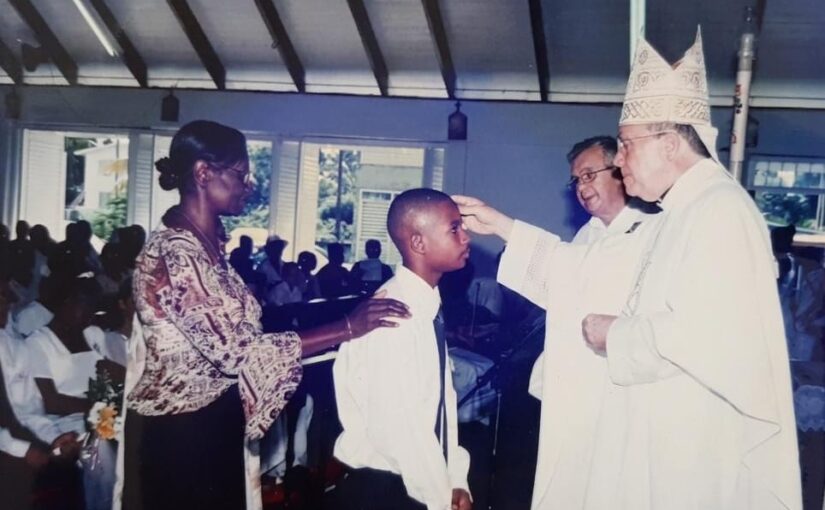
Confirmation strengthens the grace received in baptism. Through the laying on of hands and anointing with sacred chrism, the bishop says: “Be sealed with the Gift of the Holy Spirit.”
Who are we and who do we belong to? Seals are placed on important documents to show their origin and authenticity. To be sealed with the Holy Spirit means that God marks us permanently as belonging to Christ and strengthens us to represent him in the world. Confirmation identifies who we are and gives us a mission: we are Christ’s witnesses.
When we were baptized as infants, our parents, godparents, and the Christian community promised to raise us in the Catholic faith. During Confirmation, young people ordinarily renew those baptismal promises and personally say: This is my faith; I choose to live it. That personal yes is important. However, Confirmation is more than approving a decision made for us by our parents. Baptismal grace does not need our later approval in order to become effective (CCC 1308). God is the principal actor. We do not simply confirm our faith; God confirms and strengthens us in the faith received at Baptism.
Why Confirmation?
Before his Ascension, Jesus promised: “You will receive power when the Holy Spirit has come upon you; and you will be my witnesses” (Acts 1:8). At Pentecost, frightened disciples became courageous proclaimers of the Gospel. Confirmation gives us a special share in this Pentecostal grace so that we can live and witness to our faith publicly.
At Confirmation, the Holy Spirit strengthens us with seven gifts: wisdom, understanding, right judgment, courage, knowledge, reverence, wonder and awe (See CCC 1299). These gifts help us to live as disciples of Jesus and to serve others with courage, love, and faith. The traditional list comes from Isaiah 11:2–3, which describes the Spirit of the Lord resting upon the promised Messiah. Courage, for example, strengthens us to do what is right when faith is unpopular or we face peer pressure. It is always worth remembering that the sacraments are not magic. Grace is a gift that must be received and used. Some approach Confirmation because their parents force them, or friends are doing it. Others incorrectly see it as graduation from catechism.
The key question is not, “Was I confirmed?” It is: “Is the grace of my Confirmation making a difference in my life, or did I just go through the motions?”
How do I live my Confirmation?
Confirmation is a sacrament of witness and responsibility. It calls us to be unashamed of Christ. We witness when we worship faithfully each Sunday, speak truth, resist gossip and corruption, defend the mistreated, serve the poor and allow faith to shape our conduct at home, school, work and online.
The confirmed Catholic also takes responsibility for the Church’s mission. We sometimes ask, “Why doesn’t the priest say or do something?” or “Why doesn’t the Church say something?” The Church is not only the priest or bishop. We are the Church. Confirmation strengthens every baptized person to take his or her proper place in Christ’s Body. Instead of only asking what the Church is doing for us, we should also ask what the Holy Spirit is calling us to do for the Church and the world.
August, observed in our diocese as Youth Month and marked internationally by International Youth Day on 12 August, is a fitting time to remember the gift of youth to the Church. Pope Francis told young people in Christus Vivit, 178: “You are the now of God”. The energy, creativity, questions, digital skills and concern of youth for justice are gifts the Church needs now. Young Catholics can serve in liturgy, music, catechesis, media, outreach and parish planning. Adults must make room, offer mentorship and entrust them with meaningful responsibility.
Drawing on Galatians 5:22–23, the Church traditionally names twelve fruits of the Holy Spirit: charity, joy, peace, patience, kindness, goodness, generosity, gentleness, faithfulness, modesty, self-control and chastity (CCC 1832). Even if we felt nothing dramatic on the day of our Confirmation, the seal remains. Saint Paul urges Timothy to “rekindle” or “fan into flame the gift of God” within him (2 Timothy 1:6). Through prayer, the Eucharist, Reconciliation, service and courageous witness, the grace received can be stirred into flame again.
Why, then, did I get confirmed? I was confirmed so that the Holy Spirit might strengthen me to belong more deeply to Christ, take responsibility for my faith, become an active member of his Church and bear witness to him in the world. Confirmation was not my graduation. It was my commissioning.