On 21 October, the United Nations Environment Programme warned that the world can no longer avoid exceeding the internationally agreed warming limit of 1.5°C. What does this mean for us as Christians? And what does our faith call us to do?
All across Guyana, people are complaining about the heat. Air conditioning and fans offer temporary relief even as they strain our fragile energy systems. Is the climate hotter than it was twenty years ago?
Reality not Imagination
You are not imagining it! Our planet is warming. The World Meteorological Organization confirms that 2015–2025 were the eleven warmest years on record. In that period, 2024 was the hottest, while 2025 ranked second or third, depending on the dataset.
Today’s long-term warming is caused by human activities, especially burning coal, oil and gas. Extracting and processing these fuels also releases emissions. Guyana’s growing oil industry is part of this global picture. This is established science, not my personal opinion.
Climate change is already worsening heat, droughts and heavy rainfall. This will have drastic effects on rural and Indigenous communities who directly depend on the land for food. In 2024, the world recorded an annual average temperature about 1.55°C above pre-industrial levels. We must urgently reduce emissions to limit further warming and its damage. Every fraction of a degree matters. Carbon dioxide absorbed by the oceans also makes their waters more acidic.
Our pressure on creation extends beyond climate change. The Global Footprint Network estimates that humanity’s ecological demand is equivalent to about 1.7 Earths. Last I checked, we only have one!
What Does Our Faith Say?
In 2015, Pope Francis addressed these concerns in Laudato Si’, (On Care for Our Common Home). He proposed integral ecology: recognizing that care for the environment, human dignity and justice belong together. We cannot care for creation while ignoring the poor.
Genesis tells us that God placed humanity in the garden “to cultivate and care for it” (2:15). Within the Catechism, we are reminded that the seventh commandment calls us to respect the integrity of creation (CCC 2415). Polluting rivers, dumping plastics, destructive mining and reckless deforestation therefore raise moral and religious questions.
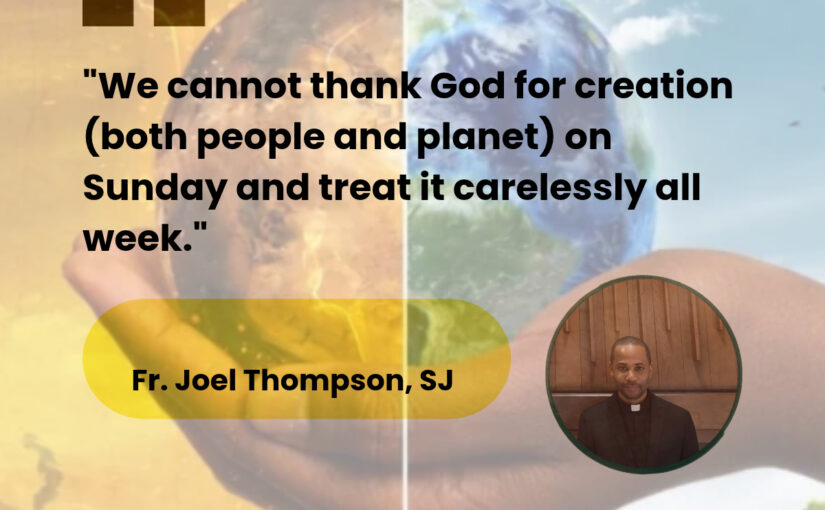
Ecological conversion means allowing our relationship with God to change how we treat creation. It begins with gratitude. Clean water, air, food and medicines are gifts received through the earth. It also requires repentance and changed habits (Laudato Si’, 217–220). We cannot thank God for creation on Sunday and treat it carelessly all week.
Christian spirituality encourages simplicity. In Laudato Si’, Pope Francis warns: “The external deserts in the world are growing, because the internal deserts have become so vast” (217). We do not need to shop to feel better about ourselves. We are already loved by God and have everything we need. The Lord is my Shepherd; there is nothing I shall want. (Psalm 23:1).
Have you heard of fast fashion? That means buying clothes simply to follow trends, then quickly throwing them away. Consumerism takes hold when having more becomes our measure of happiness and worth. Let us consume according to need, not greed.
As Guyanese Christians, we have to keep reflecting on the concept of development. Integral human development means the flourishing of every person and the whole person, including our moral and spiritual lives (Populorum Progressio, 14). Buildings and possessions are not the main measure of progress or happiness.
Greed feeds corruption, exploitation and environmental destruction. When profit matters more than people, our relationships suffer. Is Guyana getting better morally and spiritually, or only growing economically? Less poverty?
Act: What Can We Do?
On the economic side, we need greater investment in solar and wind power, responsibly planned hydropower and energy storage. Governments and businesses must reduce emissions and protect communities. Guyana’s coast lies roughly half a metre to one metre below sea level at high tide. Rising sea levels will affect us. How are we adapting to that?
As families, we can cultivate a spirit of simplicity in our lives. Let us make modest purchases, repair and reuse, conserve electricity, and dispose of rubbish properly. Some will say, “But I am poor.” Everyone can care for creation, but those with greater wealth and power have greater responsibility. Nobody should be denied basic necessities. Our parishes can organise clean-ups and support poor families struggling with food, electricity and other costs.
We should prioritize loving relationships with God, ourselves, others and creation and make this part of prayer, family life and parish life.
Caring for our beautiful creation is part of our faith and spiritual life. It is a responsibility given by God, who entrusted the earth to our care. Let us take this responsibility seriously.