“As the family goes, so goes the nation and so goes the whole world in which we live.” St John Paul II
If you were asked to list three ways of strengthening Guyanese society, what would your response be?
When we speak about strengthening society, we often think first of the economy (more cash grants and jobs), education (more schools), infrastructure (roads), or things like political institutions and security. All of these matter, but I would like us to focus on the smallest cell of society, the home.
Before a child enters a classroom, before a citizen casts a vote, before a young person attends church, there is usually a home. The family is the first place where a person learns what life means, what love feels like, and whether the world is safe enough to trust.
Vision and Reality
In the Christian vision, the family is rooted in the faithful love of husband and wife, open to life, and called to form children in love and responsibility. Genesis says, “Therefore a man leaves his father and his mother and clings to his wife, and they become one flesh” (Genesis 2:24). However, we also know the Caribbean reality. Many of our families and homes do not fit the “perfect” picture. Some children are raised by single mothers, grandparents, aunts, older siblings, step-parents, or relatives abroad who support from a distance. Some homes carry the pain of absent fathers, broken relationships, migration, poverty, addiction, infidelity, or violence. Stepbrothers and stepsisters are common. Some families are blended across races and cultures. This is our Caribbean and Guyanese reality.
The Domestic Church
The Church calls the Christian family the “domestic church.” This expression was given prominence by the Second Vatican Council, which taught that the family is “so to speak, the domestic church” (Lumen Gentium, 11). The Catechism also says that the Christian family is “a domestic church” (CCC 2204). This means that the home is meant to be a small Church, where faith is received, practiced, tested, and handed on.
Who is responsible for teaching children to make the Sign of the Cross or to pray? Where should they first learn about God, love, respect, and forgiveness? Sunday school? The priest? Granny? Parents and households are the first preachers of the faith, by word and example (monkey see monkey do). Children in Guyana begin nursery school at 3 years old but before that, their first school is the home. The first 1000 days of a child’s life critically shapes their lifelong well-being.
The Importance of Family
The first gift a family gives is belonging. A child who is loved learns, without needing a lecture, that he or she has value. In a healthy family, people learn to love and to be loved, to forgive and to be forgiven, to speak truth without cruelty, and to correct without humiliating. The Catechism calls the family “the original cell of social life” and says that family life is an “initiation into life in society” (CCC 2207). If the family is weakened, society feels it. If the family is healed, society is strengthened. Some of the social decline we see in Guyana is linked to the neglect of family life.
The family is also a school of holiness. Holiness does not mean that nobody quarrels, loses patience, or makes mistakes. It means that we slowly allow God’s grace to shape how we speak, apologize, and serve. No family is perfectly holy, but every family is called to become holy. We are on a journey.
Parents and guardians have a special role. Children need guidance, discipline, structure and boundaries, but they also need room to grow. Families nurture gifts and vocations. Sometimes parents try to live through their children, forcing them to fulfil dreams that were never really theirs. Sometimes, out of love, parents hover over every decision and never allow their children to make mistakes (helicopter parenting). Saint Paul gives a wise warning: “Fathers, do not provoke your children to anger, but bring them up in the discipline and instruction of the Lord” (Ephesians 6:4). A family should be a place where talents are discovered, affirmed, and shaped, not a place where children are crushed by comparison or fear. Many children often hear “why can’t you be like so and so”.
Listening is one of the most neglected family virtues. Many parents speak to children, but do not always listen to them. Many children hear correction, but not affirmation. Affirmation means “I love you as you are.” A home becomes more Christian when people make time to hear what another might be trying to express such as fear, loneliness, temptation, pressure, confusion or hope.
The domestic church is also a school of prayer. This does not mean that every family must gather every night with candles and hymn books. For some homes, that may be possible. For others, it may begin with the Sign of the Cross before meals, a blessing before a child leaves for school, a decade of the Rosary once a week, reading the Sunday Gospel, or asking, “What should we thank God for today?” Joshua’s words are a beautiful family motto: “As for me and my household, we will serve the Lord” (Joshua 24:15).
If Guyana needs stronger communities, safer villages, more responsible citizens, more vocations, and a more vibrant Church, we must care for the family. Parishes should not only prepare people for weddings and baptisms (hatch and match). We must accompany families after the celebration. We must support single parents, encourage fathers, protect children, care for grandparents, and help young people understand that love is not just a feeling, but involves sacrifice and commitment.
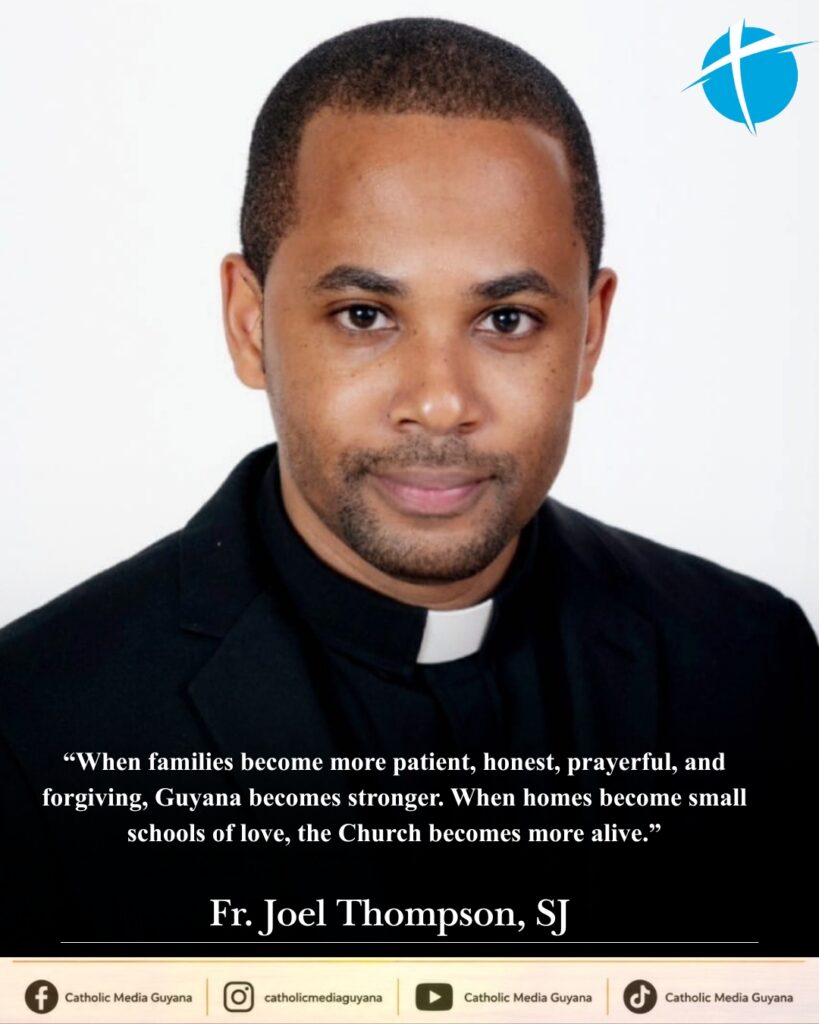
The future of society is being formed in the family. Around the table, on the veranda, in the yard, during quarrels, chores, prayers, and conversations, human beings are shaped. When families become more patient, honest, prayerful, and forgiving, Guyana becomes stronger. When homes become small schools of love, the Church becomes more alive.