Today July 14th marks 47 years since Jesuit priest Fr. Bernard Darke was murdered on Brickdam in Georgetown. Fr. Darke was killed because he was mistaken for Fr. Andrew Morrison SJ, who was the Editor of the Catholic Standard at that time. Fr. Morrison had incurred the wrath of the then government because he was one of the persons at the forefront of the struggle for democracy and human rights in Guyana.
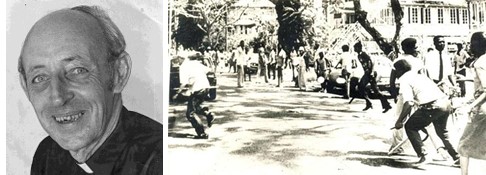
On Saturday, July 14th 1979, the Working People’s Alliance was holding an anti-government demonstration at the Magistrate’s Court where some of their leaders were answering what many felt were politically motivated charges. The demonstration followed the police van which was carrying the leaders past St. Stanislaus College on Brickdam. Fr. Darke – who taught Scripture and Maths at St. Stanislaus College and was also the Scout Master there – took a break from marking end of term exam papers and went out to take photos of the demonstration. (Fr. Darke was also a photographer for the Catholic Standard). He noticed Mr. Mike James (who was the Assistant Editor of the Catholic Standard at the time) and who had been covering the case in Court, and his wife, Maria. Suddenly the crowd was attacked by a gang of young men armed with staves, cutlasses and knives. Mr. James was attacked by three men, and fell to the ground, bleeding.
Fr. Darke, on the other side of the road, was photographing the attack. The attackers then turned-on Fr. Darke, and he started to run, but was encumbered by his cameras, strung around his neck. They beat him with staves, continuing to beat him when he fell, and took his camera. As Fr. Darke was rising, a fourth man stabbed him in the back with a bayonet. He was taken to hospital, but died that evening, at around 6 pm, from a ruptured lung.
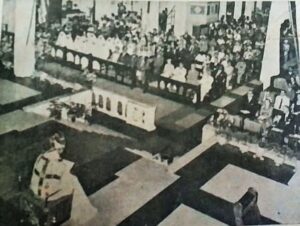
Fr. Darke’s funeral took place on Wednesday, July 25th, 1979 at the Cathedral of the Immaculate Conception, Brickdam, Georgetown. After a short service at St. Stanislaus College, Fr. Darke’s coffin was carried to Brickdam Cathedral by a group of Scouts, while crowds of people walked alongside. More than six thousand people crowded into the Cathedral and overflowed onto the streets outside. Those unable to get in listened to the service though a public address system. Some thirty priests, led by Fr. Robert Barrow, the Jesuit Superior, concelebrated the funeral mass. Bishop Benedict Singh and Anglican Bishop Randolph George, Chairman of the Guyana Council of Churches, were in the Sanctuary. The homily was delivered by Bishop Singh. He preached on Luke 23: 26—34, which speaks of Simon of Cyrene and the weeping of the women of Jerusalem, and finished with the words: “Father, forgive them…”. Bishop Singh addressed the young people present: “Bernard would want you to become men and women who would never let hatred govern your actions,” he told them, adding that they should “be sorry not for Bernard but for the violence that caused his death and for those who supported violence by failing to speak out.”
Fr. Darke was buried in the Jesuit tomb at Le Repentir cemetery. A memorial cross and stone on Brickdam mark the place where he was killed. Bernard Darke was born in the UK in 1925 and became a Jesuit in 1946, after wartime service in the Royal Navy. During formation at Heythrop, he maintained his involvement in the scouting movement and developed an interest in photography.
Following ordination in 1958, he came to Guyana in 1960 and taught at St Stanislaus College, where he transformed the scout troop and took the scouts on many trips to the Interior. Fr. Darke continued to develop his photography skills and built a dark room at his community house. His aim was to produce reliable documentation of people and events, which would improve communications between communities, people and cultures. Fr. Darke was not a public figure and was never involved in politics or controversy; which is why his murder during a political demonstration sent shockwaves through the Christian community of Guyana and the wider Caribbean. ❖
(Sources include Justice: the struggle for Democracy in Guyana 1952-1992 by Fr. Andrew Morrison SJ and Saints News & Views: Volume 22, Issue 3 – 8 Sept., 2015)