This week, we celebrate the two deeply connected solemnities of the Most Holy Body and Blood of Christ, Corpus Christi (June 7th) and the Solemnity of the Most Sacred Heart of Jesus (June 12th). Both solemnities celebrate the Lord’s never-ending and burning love for us and the gift of himself to us.
Corpus Christi is Latin for “Body of Christ.” This solemnity celebrates our Catholic belief that at every Mass, Jesus is truly present in the Eucharist: Body, Blood, Soul and Divinity. The Eucharist is not mere symbol, but Christ himself, given to us under the appearances of bread and wine. The Catechism teaches that in the Eucharist, “the body and blood, together with the soul and divinity” of Jesus Christ are truly, really and substantially present (CCC 1374).
Why Corpus Christi?
We already celebrate the institution of the Eucharist on Holy Thursday. But Holy Thursday takes place during Holy Week, when the Church is already entering deeply into the Passion of the Lord. Corpus Christi developed as a special feast of joy, praise and public thanksgiving for the gift of the Eucharist.
The feast was first celebrated locally in Liège, Belgium in 1247, after the efforts and Eucharistic devotion of St. Juliana of Liège. Later, Pope Urban IV extended it to the universal Church in 1264. He also asked St. Thomas Aquinas to compose prayers and hymns for the feast. From St. Thomas, we have received some of the Church’s most beautiful Eucharistic hymns, (still used today) including Pange Lingua and Tantum Ergo.
Tradition also connects the spread of Corpus Christi with the Eucharistic miracle of Bolsena, Italy (1263) where a priest who struggled to believe in the Real Presence witnessed blood coming from the consecrated Host. Such Eucharistic miracles over the centuries have served to strengthen the Church’s devotion to the Eucharist.
The Eucharist and the Sacred Heart
There is a beautiful connection between Corpus Christi and the Solemnity of the Sacred Heart of Jesus. Historically, the key moment is linked to St. Margaret Mary Alacoque. In 1675, she reported that Jesus asked for a feast in honour of his Sacred Heart to be celebrated on the Friday after the great celebration of Corpus Christi.
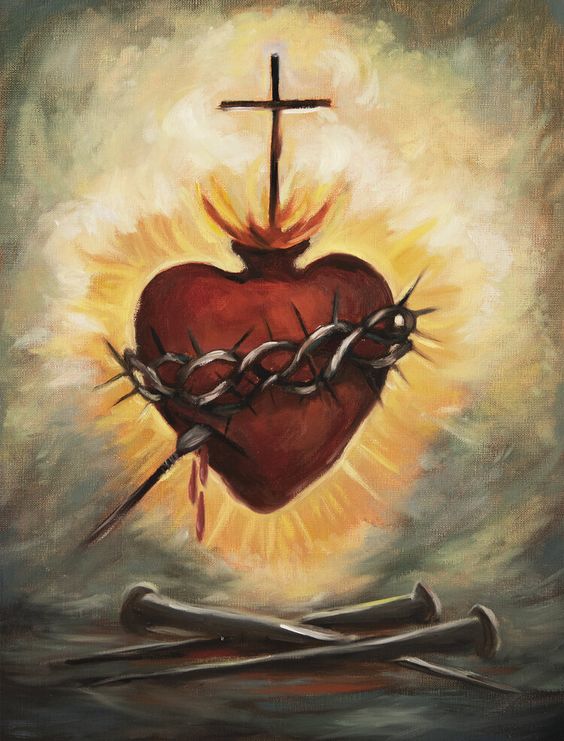
The closeness of the two feasts suggests that the Eucharist is none other than the Heart of Jesus himself. When we look at the image of the Sacred Heart, we see a heart surrounded by fiery flames. These flames are not decoration. They depict the burning love of Jesus for humanity. His heart is wounded, pierced with thorns, and yet still burning with love. This is the same love present in the Eucharist. The Eucharist is the Heart of Jesus still giving himself to the world.
Pope Francis, in Dilexit Nos “He Loved Us” reminds us that devotion to the Sacred Heart does not distract us from Jesus. It leads us directly to him, “who calls us to a precious friendship marked by dialogue, affection, trust and adoration.” (Paragraph 51).
In Eucharistic adoration, we come before Jesus not simply to look at the Host, but to be looked upon by Christ himself. We bring our worries, sins, tiredness, hopes, families, parish, country and world before the Lord. In adoration, we allow the Heart of Jesus to speak to our hearts.
A Heart of Flesh
Some Eucharistic miracles have deepened this connection between the Eucharist and the Sacred Heart. In the well-known miracle of Lanciano, Italy, scientific studies reported that the flesh was human heart tissue and that the blood was type AB. Other reported Eucharistic miracles have also been associated with heart tissue and AB blood (e.g. Buenos Aires (1996), Sokolka (2008), Tixtla (2006). These miracles are not the foundation of our faith. Our faith rests on the words of Jesus: “This is my body… this is my blood” (see Matthew 26:26-29). These words remind us that the Eucharist is not an idea, but is the living Christ, who is the love of God made flesh.
Why Processions and Adoration Matter
On Corpus Christi, many parishes throughout the world hold Eucharistic processions. The Blessed Sacrament is carried through the streets. This is public proclamation that Christ is Lord not only inside the church, but in our homes, schools, hospitals, workplaces, markets and streets.
The procession also teaches us that the Eucharist is not meant to keep us closed in on ourselves. We receive Christ so that we may become more like Christ. We adore him so that we may love like him. We kneel before the Eucharistic Heart of Jesus so that we may stand up for the poor, forgive those who hurt us, care for the sick, and build peace.
Pope Leo XIV’s Dilexi Te reminds us that God’s love comes close to human poverty and suffering. God’s love is not distant. It descends, takes flesh, and cares for our wounds. This is exactly what the Eucharist is. Jesus comes close to us to feed us with himself.
Our Response to Love
The central question of Corpus Christi and the Sacred Heart is: How will we respond to this love? If Jesus gives us his Body and Blood, what can we give to him? If his Heart burns with love for us, can our hearts remain cold? If he gives himself completely, can we continue to live selfishly?
The Eucharist is the sacrament of love. The Sacred Heart is the image of love. Together they tell us that Christianity is not a religion of fear or empty rules and rituals. Christianity beautifully proclaims that God loves us, gives himself for us, and draws us into his own life.
May these two solemnities help us to love God more deeply and to love our neighbour more generously. Let us spend time in adoration. Inspired by the Sacred Heart, let us go out to set the world on fire with the burning love of Christ.